
While many visitors to Campbell River and the surrounding coast come hoping to spot giant whales and fuzzy bears, spring is also an exceptional season for birds. Some of the species we encounter live along our coast year-round, while others become more active and visible as the season changes. Although birds are often overlooked in favour of larger wildlife, they are an equally fascinating part of the coastal ecosystem and can provide some truly spectacular sightings in spring. Here are some incredible facts about 10 of our most commonly seen bird species!
- Common Murres (Uria aalge) have been recorded diving to depths of up to 180 m (590 ft), which is comparable to the average dive depth of a Humpback Whale.
- Black Oystercatchers (Haematopus bachmani) don’t actually eat oysters. Instead, they primarily feed on mussels, limpets, barnacles, and marine worms.
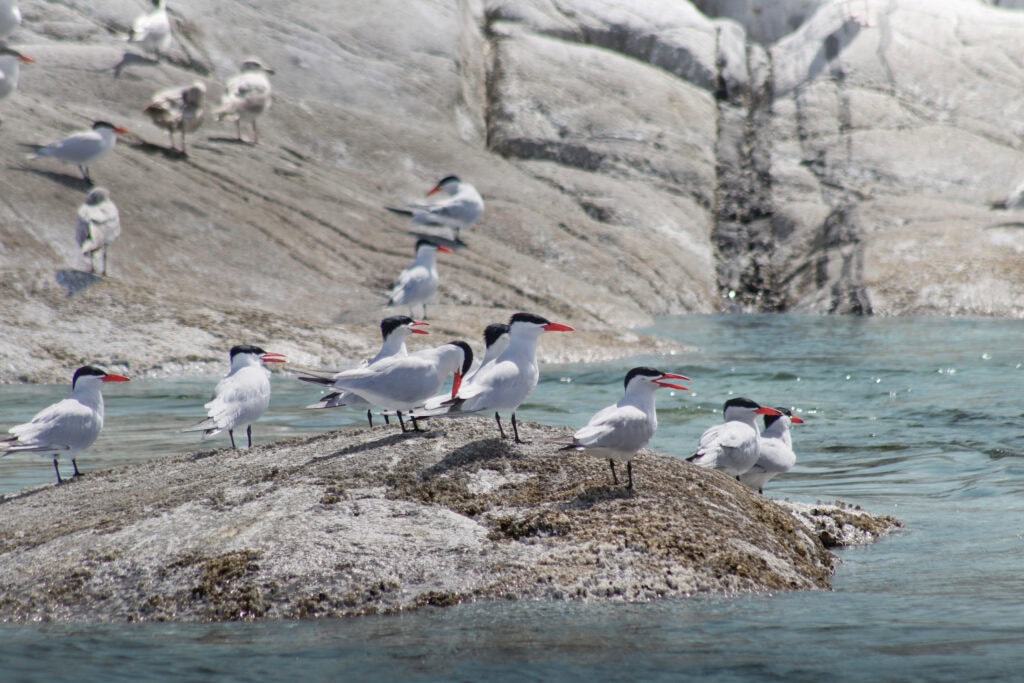
- With a wingspan of up to 128 cm (50 in), Caspian Terns (Hydroprogne caspia) are the largest tern species in the world. Centre Islet, east of Cortes Island, is also their northernmost breeding colony on the west coast.
- Marbled Murrelets (Brachyramphus marmoratus) nest high in old-growth forests and may commute up to 100 km each day to deliver a single whole fish to their chick.
- Rhinoceros Auklets (Cerorhinca monocerata) are closely related to puffins and, like them, have beaks that glow under ultraviolet light.
- During breeding season, Pigeon Guillemots (Cepphus columba) become highly vocal and perform synchronized aerial displays while emitting high-pitched squeaky whistles.
- Bald Eagles (Haliaeetus leucocephalus) do not develop their iconic white head and tail plumage until they are around 4–5 years old.
- The small Bonaparte’s Gulls (Chroicocephalus philadelphia), named after Napoleon Bonaparte’s nephew, feed using a highly coordinated “conveyor belt” technique. As the flock forages into the wind, birds at the front peel away and circle back to the rear, creating a continuous feeding motion over the water’s surface.
- Because they forage in turbulent white-water habitats, Harlequin Ducks (Histrionicus histrionicus) suffer more broken bones than any other bird species. X-rays and museum specimens show that most adults live with multiple healed fractures.
- Surf Scoters (Melanitta perspicillata) are “molt migrants.” After nesting, adults travel to specific molting areas where they shed and regrow their flight feathers, becoming temporarily flightless before continuing to their wintering grounds.
Keep an eye out for these amazing species from shore or join us on a tour for the chance to see them thriving in their natural habitat!

Written by Rosalie Burauen
Rosalie is a naturalist and guest experience team member at Campbell River Whale Watching. Originally from Germany, she is currently studying Biology at Vancouver Island University in Nanaimo and is passionate about marine mammals, seabirds, and ocean conservation. Rosalie enjoys helping guests connect with the incredible wildlife of Vancouver Island - especially humpback whales, orcas, and coastal bird species.